
How To Find Your Property On FEMA’s Flood Insurance Rate Maps

What are FEMA flood maps?
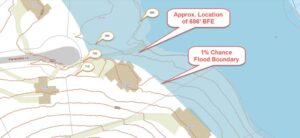
FEMA’s Flood Insurance Rate Maps (FIRMs) or just Flood Maps are provided after a flood risk assessment has been completed or updated for a community.  This study is known as a Flood Insurance Study.  The FIRM gives you the Base Flood Elevations (BFEs) and insurance risk zones in addition to floodplain boundaries.  The FIRM may also show a delineation of the regulatory floodway.

Once the “insurance risk zone”  (commonly referred to as the flood zone) is determined, actuarial rates, based on these risk zones, are then applied for newly constructed, substantially approved, and substantially damaged buildings.  FEMA uses these rates to determine the insurance rate you will pay for flood insurance

FEMA’s Digital Flood Maps

FEMA discontinued the production and distribution of paper flood maps in 2009 as part of its Digital Vision Initiative. This affected all the Flood Maps, boundary information, and study reports. However, clients can still view the products for free through their website or buy them in digital format.

To view these flood maps online, go to FEMA’s Map Service Center and key in your address (hi-lited area shown here) search for your home.  This will prompt you to then select the map that covers your area.  The Flood Maps are somewhat cumbersome to use online. It is best to go through the tutorial on the bottom right of the address search page for an easier and more effective use of the GIS map.
More Posts

Why Remote Sensing Technology Matters More Today

Land development is changing as new tools make it easier to understand complex terrain. Remote sensing technology is now one of the most important tools in modern surveying. In areas like Bridgeport, WV, where land conditions can vary, having accurate data early makes a big difference. Why Remote Sensing Technology

Read More »
Aerial view of a land subdivision showing lot boundaries and measurements from a lot survey used for planning and layout
land surveying
Surveyor

A Lot Survey Can Prevent Final Plat Delays

You’ve got land. You’ve planned out your lots, and everything looks right on paper. So you move forward, expecting a smooth approval. Then the city reviews your plan—and suddenly, things stop. Maybe one lot is slightly too small. Maybe access doesn’t meet local rules. Or maybe the layout just doesn’t

Read More »
Residential building near water showing how a FEMA elevation certificate can help determine flood risk and insurance costs
flood damage
Surveyor

Can a FEMA Elevation Certificate Lower Insurance Costs?

If you live in Bridgeport, WV, you may have seen your flood insurance cost go up. It can feel confusing and unfair. You might wonder, “Why is my rate so high?” The truth is, many homeowners pay more than they should. However, there is a way to check if your

Read More »
Drone capturing terrain data during lidar mapping to create a detailed land surface model
land surveying
Surveyor

How LiDAR Mapping Is Changing Property Data

Technology keeps changing how people understand land. Recently, cities and counties started using lidar mapping to make very detailed maps of neighborhoods and large areas. This technology collects millions of measurements from the ground. Because of this, planners and engineers can see land features much more clearly. Most news stories

Read More »
Homeowners discussing property lines with a surveyor during a boundary survey to clarify property limits
boundary surveying
Surveyor

How a Boundary Survey Prevents Property Line Disputes

Property lines may look simple on paper. However, in real life, they often cause tension between neighbors. A fence gets built. A shed appears near the edge of a yard. Soon, two people believe the same strip of land belongs to them. Stories like this happen often across the country.

Read More »
Homeowners reviewing an insurance bill at home before ordering an elevation survey
flood damage
Surveyor

Before Insurance Rates Rise, Get an Elevation Survey

You open your insurance renewal notice and your stomach drops. The premium jumped. You haven’t flooded. You haven’t changed anything. So why did the cost go up? Across the country, flood insurance pricing has shifted. Insurers now rely more on property-specific data instead of broad flood zones alone. That means

Read More »